
Welcome
Welcome to the February edition of our newsletter, a month which saw the publication of the Government’s White Paper on SEND, Every child achieving and thriving – GOV.UK. We are considering our response and will share this with you very soon.
The independent report from the Government’s Neurodivergence Task and Finish Group was published on the same day and makes four key recommendations or ‘big ideas’. You can read it here: Neurodivergence Task and Finish Group: report – GOV.UK
Non-attendance at school – a significant issue for autistic children and young people.
We know from research by one of our Director’s, Ruth Moyse, that autistic children and young people are significantly more likely to be ‘persistent absentees’ from school than their non-autistic peers. We also know that the percentage of young people who fall into this category has only risen since COVID.
This month, an article in The Guardian included details of a new report by Ambitious about Autism, which found that one in six autistic pupils in UK have not attended school at all since September.
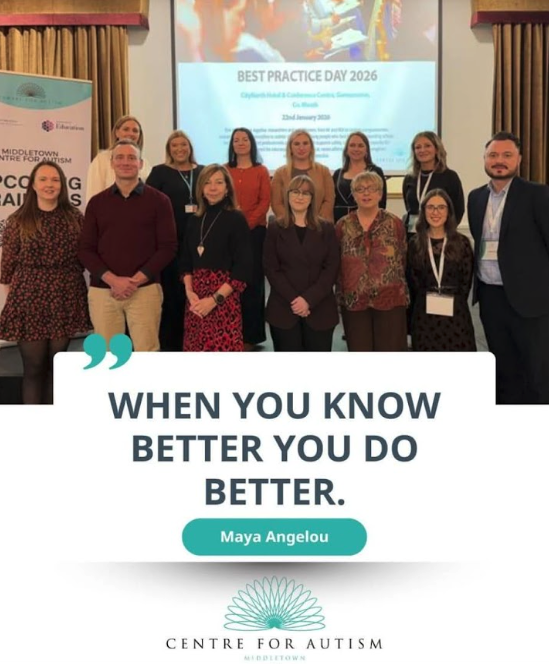
Work to understand and address this issue continues, and Ruth travelled to Ireland this month to speak at Middletown Centre for Autism’s Best Practice Day 2026, ‘Can’t, Not Won’t – Reframing School Non‑Attendance for Autistic Students’. This event was an opportunity to explore compassionate, contemporary understandings of why so many autistic young people stop attending school, and what we need to change in our own practice to provide a safe, inclusive environment where these children feel seen, accepted and that they belong.
Part of the solution is working with teachers and trainee teachers to shift the narrative from ‘school refusal’ to being no longer able to attend, often after years of persevering. As part of this, Ruth has facilitated workshops for the University of Southampton’s PGCE cohort, building understanding and reflection.
“Honestly, this has been so interesting and enlightening. It has given me a stronger idea of strategies to help my pupils and has made me excited to adapt my lessons! Thank you.”
“Brilliant. It’s validated how I feel we should be as a teacher / human!”
If you would like to hear Ruth talking about non-attendance, you can catch her on Autism Central’s webinar on 13th March, where she will be in conversation with Dr Myrto Kakoulidou. Supporting young people who are absent from school | Autism Central
Director’s comment
Chris Atkins, Head of Policy, Education and Social Care
 It was interesting to read the government’s response to the House of Lords Select Committee Report ‘Time to deliver: The Autism Act 2009 and the new autism strategy’ which was published at the end of January. The effective implementation of the worthy aspirations contained within the Autism Act, now into its 15th year, has been a source of ongoing frustration and disappointment for many of us and so the House of Lords update report did offer some hope with its call for the immediate development of an all-age, cross-bench autism strategy, a restructuring around core themes, a focus on the meaningly involvement of autistic people, and the need to deliver person-centred, flexible, and responsive support. However, the government’s response quickly re-established the tired and ineffectual status quo with its predictable failure to offer any clear implementation plan, the absence of actual costed, deliverable plans, and the glaring lack of true accountability for persistent failures. Despite acknowledging the long-standing systemic problems that have been well-documented, vague, broad commitments were presented rather than concrete, measurable outcomes within a clear structured path for reform. Several autism charities have called the response “dismissive” and variously described it as overly vague, under-funded, non-committal, and insufficiently accountable noting genuine fears that autistic people will continue to face significant – but eminently addressable – barriers to a full and genuinely participatory life within our communities. Rinse and repeat for the time being then…
Courses and services
 SPELL Framework
Stage 1 online SPELL training course. This is a 2-day course, with the next event scheduled for Friday 27th March and 10th April. Stage 1 SPELL Framework training – AT-Autism
Stage 2 SPELL Train the Trainer course. This 1-day in-person course is next scheduled to be delivered on Thursday 9th April, in Reading. Stage 2 SPELL Framework Training – AT-Autism
You can also email us to make a booking, or enquire about closed or bespoke courses for your organisation, at info@atautism.org
 Synergy Programme
Please contact us at info@atautism.org to book training on the Synergy Programme. This training has a primary focus on the narrative, the practitioner and the culture of a setting – not the ‘behaviour’ of the autistic person being supported. To improve practitioner skills and wellbeing and reduce stress.
Other Services
Click the links for information on the other services we offer:

Autism Central
We are pleased to be working with Anna Freud on the Autism Central programme, providing Peer Supervision to the Peer Family Guides. Autism Central is England’s national autism peer education programme, designed to support families and the wider support networks of autistic people. More details here: Autism Central – England’s Peer Education Programme | Autism Central
Peer Family Guides provide one-to-ones which are open to autistic and non-autistic family members of all ages and carers – including parents, partners, siblings, adult children, grandparents, relatives – as well as friends, colleagues, and neighbours. People can have up to 10 sessions with a Peer Family Guide, by phone or video call, and each session lasts for 50 minutes.
“Connecting to someone who gets it”; “Being able to talk freely and with ease and support.”; “It was amazingly helpful.”
Autism Central is England’s national autism peer education programme, designed to support families and the wider support networks of autistic people.

Your Title Goes Here
Coaching Autistic People through Sport (CAPS)
The next public delivery of the Coaching Autistic People through Sport course, developed in partnership with Strong Path, and endorsed by CIMSPA, is in Reading on 23rd and 24th April 2026. To book a place on these dates, or to arrange delivery of the course to your organisation, please contact info@atautism.org